Abeyon
  • About Abeyon
    • Who we are
    • Customers
    • Vehicles
  • Capabilities
    • Secure AI solutions
    • Data Engineering & Analysis
    • IT Modernization & Digital Transformation
    • Application Development
  • AI Studio
  • Case Studies
  • Insights
  • Join
  • Contact
  • Menu Menu

Design Based Development Requires A New Approach

List List Menu
  • Top
  • Experience
  • Solutions
  • Our Process
  • SCRUM Development
Intelligent Process Automation

Intelligent Process Automation – Why is it important?

April 7, 2022/in AI, Deep Learning, Machine Learning, NLP, Text Analysis/by Mallesh Murugesan

Intelligent Process Automation is the combination of different technologies to automate more complete, end-to-end business processes

Government agencies and enterprises have been performing business process improvements for the past several years to improve efficiency within their internal processes, reduce waste in internal workflows and streamline business functions. This has led to human workers performing tasks more efficiently. However, this consequently has led to humans performing high volumes of repetitive, mundane tasks leading to burn-out and increasing risks for human error.

Today, advances in technology have enabled the automation of human tasks, especially those that are repetitive and mundane, as well as those that involve a certain level of cognitive functionality (i.e., “decision-making”). This has enabled government agencies and enterprises to enter the next level of creating efficiency by automating functions using methods ranging from simple workflow automation to complex intelligent process automation (IPA). For instance, IPA holds the promising potential to expand automation capabilities to include additional and more complex workflows and functions that utilize both structured and unstructured data. IPA combines Cognitive/Artificial Intelligence (AI) and Robotic Process Automation (RPA). The AI provides the intelligence (i.e., the “brains”) of the process while RPA provides the processing (hands) of functional workflows. RPA, which is fundamentally rule-based with limited capabilities, enables IPA to yield high returns and better business outcomes for processes that involve well-defined rules, are repetitive, require access to multiple systems, have manual steps following Standard Operating Procedures, and have a high possibility for human error.
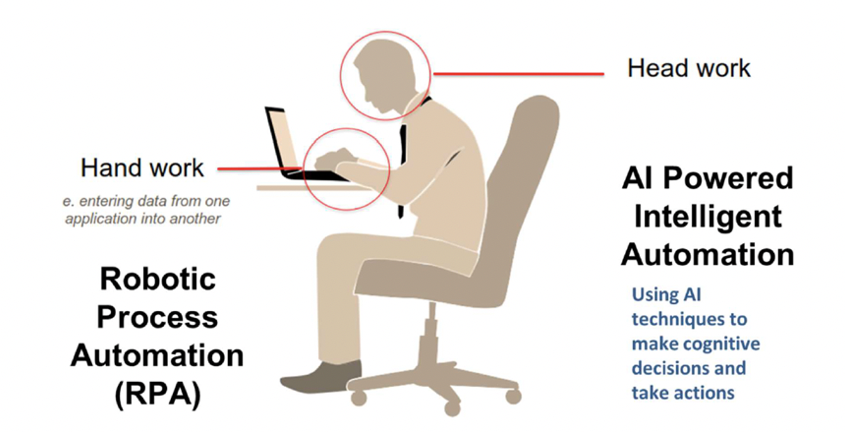
Intelligent Process Automation

Image Reference: https://www.actiac.org/documents/act-iac-white-paper-intelligent-automation-playbook-rpa – October 30, 2019

However, currently, most government agencies and enterprises are solely just implementing RPA- based automation in an attempt to improve workflows and functions that typically require less cognitive decision-making steps, but are only witnessing moderate success. The low-hanging fruit for intelligent automation is data-intensive and repetitive tasks that machines can do better and faster than humans. Many applications will keep a “human in the loop”—at least until the system has proven its reliability. Even then, AI systems by their nature learn (both in supervised and unsupervised ways) and therefore change, so they need to be reviewed on an ongoing basis to ensure they are still performing as intended.

Due to these limitations, this has led to more adoption of IPA-based solutions across agencies and enterprises which has dramatically improved organizational efficiency, reduce costs, and increase customer satisfaction levels. AI-enhanced automation can significantly expand the scope of process automation to new and exciting areas that were previously considered too complex for consideration. For instance, a primary objective of IPA is to provide the human workforce with additional knowledge, support, and insights by automating repetitive, manually-intensive, and otherwise mundane tasks. With IPA, organizations can amplify human potential and move employees from low-value work to high-value work. As an example, Abeyon is employing IPA to “read” and analyze voluminous quantities of unstructured documents to extract datasets and utilize them for further analysis.

For agencies and enterprises to adopt IPA into their businesses, a well thought-out long-term plan is needed since the ROI on IPA work will take longer than simple automation. Since AI models will need large sets of datasets to be trained on, a large initial investment will be needed to see long-term value. This involves creating a very clear picture of the cost and benefits of IPA efforts. Abeyon has worked with several government agencies and enterprises to realize the power of AI and how IPA can greatly increase value of automation.

Contact us at info@abeyon.com if you are interested in learning more. Want to learn more about AI concepts? Click here to see our Insights series

https://abeyon.com/wp-content/uploads/2019/05/AI-Network.jpg 394 860 Mallesh Murugesan https://abeyon.com/wp-content/uploads/2015/03/logo_abeyon_big-gray-300x85.png Mallesh Murugesan2022-04-07 16:51:422022-04-07 16:52:39Intelligent Process Automation – Why is it important?
Topic Modeling

With document democracy, we go beyond traditional Topic Modeling

May 12, 2021/in AI, Deep Learning, Machine Learning, NLP, Text Analysis/by Mallesh Murugesan
Read more
https://abeyon.com/wp-content/uploads/2021/05/Data.jpeg 895 1392 Mallesh Murugesan https://abeyon.com/wp-content/uploads/2015/03/logo_abeyon_big-gray-300x85.png Mallesh Murugesan2021-05-12 22:13:372021-05-12 22:13:37With document democracy, we go beyond traditional Topic Modeling
NLP

Bring clarity to unstructured data using Natural Language Processing (NLP) – Part 2

November 5, 2020/in AI, Deep Learning, Machine Learning, NLP, Text Analysis/by Mallesh Murugesan

Natural language processing (NLP) is a branch of artificial intelligence that helps computers understand, interpret and manipulate human language, in particular how to program computers to process and analyze large amounts of natural language data.

This is series 2 of the introduction to key capabilities of NLP technologies. Here is the link to Series 1 of this article. With recent advances in Artificial intelligence technologies, computers have become very adept at reading, understanding, and interpreting human language. Here a few additional NLP capabilities that have made that possible.

Text Clustering: 
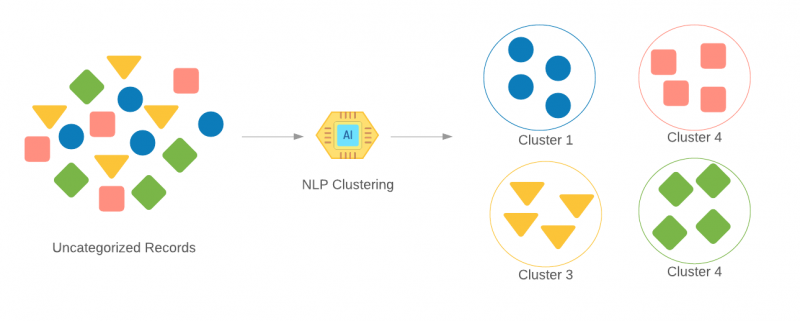
Clustering in general refers to the grouping of similar data together. Text clustering is a technique used to group text or documents based on similarities in content. It can be used to group similar documents (such as news articles, tweets, and social media posts), analyze them, and discover important but hidden subjects. Text classification as we discussed before also puts objects in a group, but the major difference between clustering and classification is that classification is a supervised method whereas clustering in an unsupervised method. All objects/data within clustering are new and no the resultant groups are unknown. This method is heavily used to identify key topics, patterns in large data sets as the first step to classification.

Text Clustering NLP

Text Summarization: 
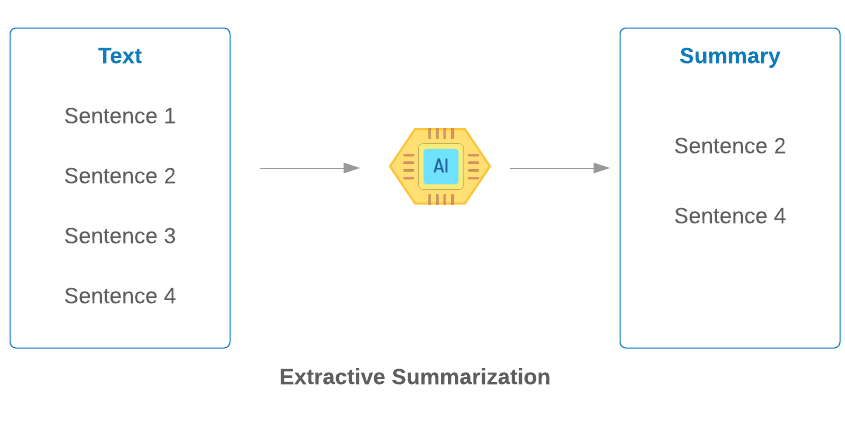
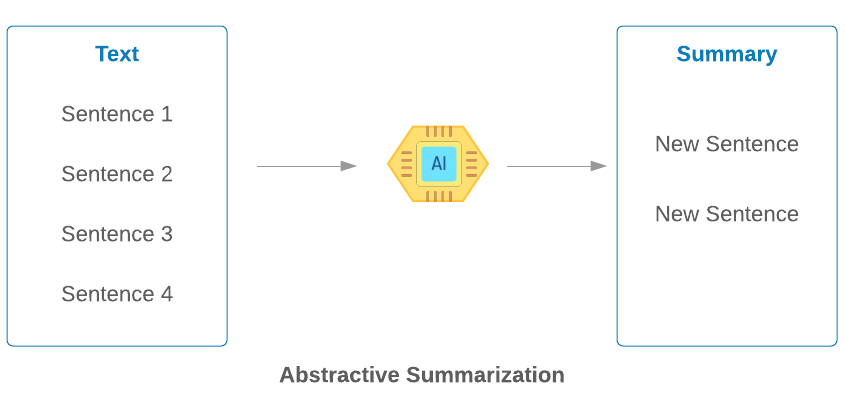
Text Summarization refers to the technique of producing a concise summary of long pieces of text while preserving key information, content and overall meaning. There are many reasons and uses for a summary of a larger document. One example that might come readily to mind is to create a concise summary of a long news article, but there are many more cases of text summaries that we may come across every day. There are two different approaches that are used for text summarization: Extractive Summarization, Abstractive Summarization. Extractive Summarization identifies the important sentences or phrases from the original text and extracts only those from the text. Abstractive Summarization generates new sentences from the original text.

Extractive Text Summarization

Abstractive Text Summarization

Relation Extraction:
Relationship extraction refers to the technique of extracting semantic relationships from a text. Relationship Extraction products attributes and relations for entities in a sentence. For example: given the sentence “John was born in Fairfax, Virginia” a relation classifier aims at predicting the relation of “bornInCity”. Relation Extraction is the key component for building relation knowledge graphs, and it is of crucial significance to natural language processing applications such as structured search, sentiment analysis, question answering, and summarization.

These techniques combined with techniques discussed in series 1, can provide tools to create value from the deluge of unstructured data found within government agencies and other organizations. There is much to be learned from the potential of AI and, in particular, its ability to analyze masses of unstructured data

Want to learn more about AI concepts? Click here to see our Insights series

https://abeyon.com/wp-content/uploads/2019/06/Keyphrase-extraction.jpg 3456 4608 Mallesh Murugesan https://abeyon.com/wp-content/uploads/2015/03/logo_abeyon_big-gray-300x85.png Mallesh Murugesan2020-11-05 12:26:552020-11-05 12:26:55Bring clarity to unstructured data using Natural Language Processing (NLP) – Part 2
Page 2 of 9‹1234›»

Every organization faces a unique set of challenges and opportunities

That’s why, we design our solutions by listening to our clients and keeping design in every step of our process.

OUR PROCESS

Search Search

Categories

  • AI
  • Deep Learning
  • Events
  • In The News
  • Machine Learning
  • NLP
  • Text Analysis

Sign Up For Our Mailing List

Archives

  • February 2025
  • February 2024
  • May 2023
  • April 2022
  • May 2021
  • November 2020
  • November 2019
  • September 2019
  • August 2019
  • June 2019
  • May 2019
  • April 2019
  • March 2019
  • February 2019
  • January 2019
  • November 2018
  • February 2018
  • October 2017
  • September 2017
  • August 2017
  • July 2017
  • November 2016
© Copyright 2018 - Abeyon
  • CY 2024 Greenhouse Gas Emissions
Scroll to top Scroll to top Scroll to top